ETH MERGE

The Merge is the next step in the evolution of Ethereum.

ETHEREUM 2.0

About ETH MERGE

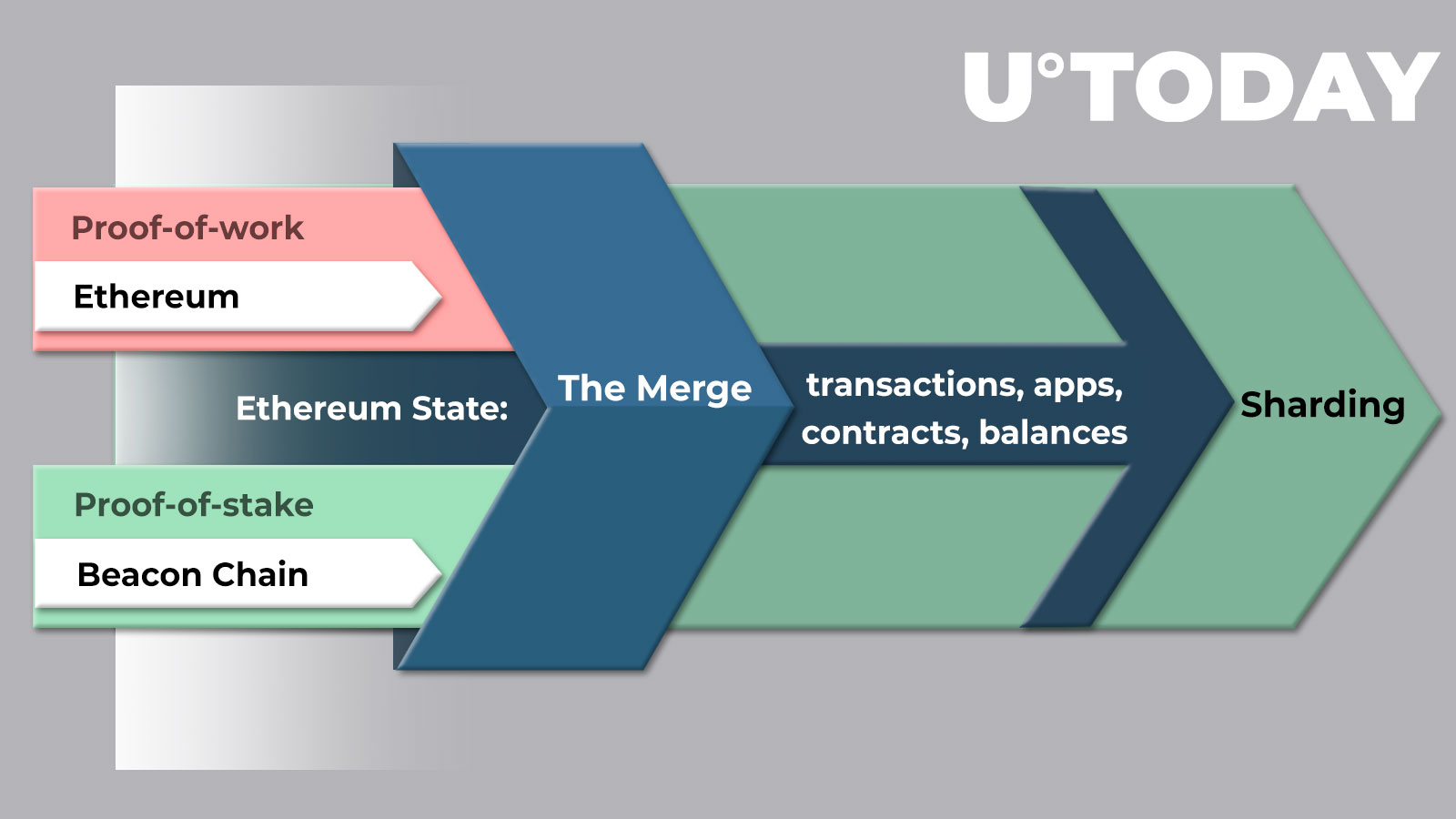
The Merge is the next step in the evolution of Ethereum. It is an upcoming event that will see the existing execution layer merged with the recently deployed consensus layer (the Beacon Chain) — this will form a mainnet platform secured by proof-of-stake, while still maintaining the original Ethereum state.

Buy Now
Mission & Vision

Right now, there are two independent blockchains for Ethereum operating in isolation. These are the current proof-of-work (POW) Ethereum chain and a separate proof-of-stake Beacon Chain.

Following the merge, the Beacon Chain (currently used only for testing) will act as Ethereum’s consensus layer, and will store and manage the registry of validators — these validators will help secure the network by bundling transactions into blocks for addition to the blockchain. Meanwhile, Ethereum’s POW mechanism will be permanently scrapped.

What Is The Merge?

The Merge aims to dramatically improve the efficiency of the Ethereum platform by eliminating the need for energy-intensive mining. It instead allows a network of validators to take over the role of block production and consensus.

Following The Merge, Ethereum’s energy usage and carbon footprint will decrease by approximately 99.95%, tackling one of the major sticking points for regulators, developers and users — its environmental impact.

Artificial Intelligence

It is expected that The Merge will help to further decentralize Ethereum by democratizing access to the validator set. Over time, this will also improve its security, since more participants will make it harder and more costly to coordinate a 51% attack.

TThe Merge will also help lay the foundations for further upgrades that will improve Ethereum’s scalability — potentially including support for sharding and verkle trees.
Virtual Reality

The Merge is currently expected to take place on September 15, 2022. That said, this is a soft deadline, which means it is subject to change.

Augmented reality

For Ethereum users, The Merge will not lead to a noticeable change when it comes to interacting with Ethereum DApps or submitting transactions — most wallets and centralized platforms will continue to work as usual.
Special Podcast: Ethereum's Merge Explained

We're joined by four top guests — two who are supporting the switch to Proof-of-Stake, and two who are against.

Proof of Work vs Proof Stake

Proof of Work vs Proof of Stake, we’ve all heard the terms, often framed as one against the other, like Coke and Pepsi. But at its core, they both try to solve the same problem, the consensus of trust in a blockchain network.

However, the issue of achieving consensus has ignited a fiery disagreement between the two camps.
Contact Us

FAQ

Q: Will The Merge reduce my Ethereum gas fees?
A: No. The switch from proof-of-work to proof-of-stake does not actually change anything about the network that would lead to lower gas fees. It’s only with later improvements, including the 2023 sharding upgrade, that should see Ethereum's throughput dramatically increase as blocks are produced in parallel — bringing down fees as a result.
Q: Will The Merge increase Ethereum transaction times?
A: No. The Merge will actually slightly decrease Ethereum transaction times. Under proof-of-work, Ethereum generates a block every 12-14 seconds (currently averaging at 13.36 seconds). Following The Merge, a new block will be generated every 12 seconds — more than 10% faster than before. This will mean transactions will be confirmed roughly 10% faster in most cases.
Q: Will The Merge cause Ethereum to go offline?
A: No. Ethereum will continue to operate during The Merge. However, many exchanges will likely pause deposits and withdrawals on the Ethereum network for several hours while The Merge is carried out.
Q: What will Ethereum miners do after The Merge?
A: Ethereum miners will no longer be able to help secure the network following the merge, and as such, will no longer earn block rewards. Some miners may transition to other GPU-mined proof-of-work coins like Ethereum Classic (ETC) and Ravencoin. They might also dedicate their hardware to other GPU-intensive activities, such as machine learning or rendering farms. There is also a fair chance that a POW Ethereum fork will arise, which will allow miners to continue their operations.
Q: Will staking APR increase after The Merge?
A: Ethereum.org notes that staking yields are likely to increase after The Merge, as transaction fees begin to go to validators, rather than miners. The site predicts that APR for staking on Ethereum will increase to ~7% after The Merge. Research earlier this year from Coinbase predicted that staking yields would increase to over 9-12% APR, based on the fact that the Beacon Chain’s staking reward was between 4.3-5.4%.
Q: Can staked ETH be withdrawn after The Merge?
A: Not right away. Staked ETH will remain locked on the beacon chain for around 6-12 months, until the Shanghai upgrade takes place. Validators will need to exit the active validator set to withdraw staked ETH. There is a limit to the number of validators that can leave each epoch. Withdrawals will be enabled following the planned Shanghai upgrade.
Q: Is The Merge the same as ETH 2.0?
A: Eth 2 is now known as the consensus layer, whereas the original POW chain (Eth 1) is known as the execution layer. Together, these are known simply as Ethereum.
Q: How many ETH do you need to stake to run a node after The Merge?
A: Following The Merge, you'll still need to stake at least 32 ETH to activate your own validator. However, you will also be able to share a validator with other people through pooled staking (including liquid staking solutions), staking-as-a-service platforms, and centralized exchanges. If you don’t have 32 ETH to stake, you can also run a node that does not propose blocks — this will still support the network by listening for new blocks to verify them.
Q: What is the Goerli testnet?
A: Goerli is one of a handful of Ethereum testnets. It is used by developers looking to bug and stress test their applications before deploying on the Ethereum mainnet. It was the last testnet to complete the merge and switch to proof-of-stake, setting the stage for the main event in September.
Q: Will Ethereum use shard chains after The Merge?
A: No. Shard chains are not expected to be implemented until 2023.